What is connected lighting?

Connected lighting links luminaires and controls so they can communicate within a lighting system. Depending on the project, switches, sensors, control modules and other connected components can be used to adjust or automate the lighting.

The connection itself can be wired or wireless. Wireless solutions can use technologies and systems such as Zigbee, Casambi or Philips Hue.

Smart lighting takes this a step further. The lighting can become part of a wider ecosystem that also includes applications such as sensors, apps, voice control, window blinds and entertainment systems.

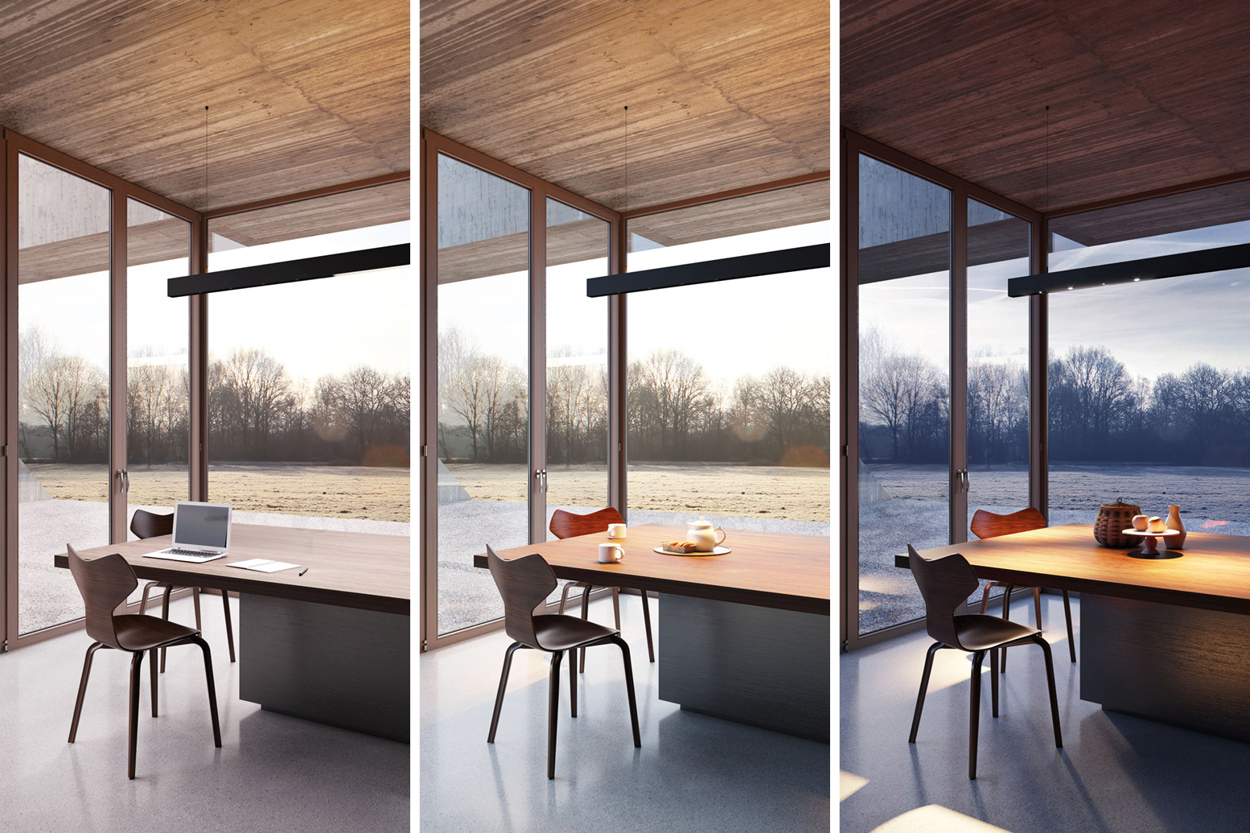
  • Home office with three different lighting routines
  • Why specify smart lighting?

    Smart lighting makes it easier to adapt light to different activities and moments throughout the day.

    In an office, lighting scenes can support different uses of a meeting room. In hospitality interiors, different settings can create the right atmosphere throughout the day. At home, connected lighting can respond to daily routines or be controlled remotely.

    Integration with other smart applications adds another level of control. Lighting can work alongside blinds, sensors or other connected devices rather than operating as a separate installation.


    Discover our projects

Smart lighting and energy efficiency 

Smart lighting can help reduce unnecessary energy consumption. Occupancy sensors can switch or dim lighting when a space is empty, while daylight sensors can adjust artificial light according to the amount of natural light available. 

These functions are not limited to wireless lighting. Wired systems can use sensors in much the same way. A wireless sensor mainly offers greater freedom during installation because it doesn’t require additional control wiring. 

Combined with efficient LED lighting, these controls help ensure that light is used when and where it’s needed.

Where can smart lighting be used?

  • In offices, lighting can respond to occupancy, daylight and changing activities.

    Office

Connected lighting powered by Hue & Casambi

A simple click, touch, swipe, sound, or even physical presence, is all it takes to control light in a space and adapt it to an activity or to create mood. With the use of smart devices, bring safety and comfort to a space, and let there be light.

Philips hue
Casambi

Light control, with one single touchpoint

Turning lights on/off, or dimming them. Adjusting intensity, setting up light routines and in/out modes with an easy setup and features. Using remote control from anywhere, anytime. Yes to all.

Enhance your client’s experience with advanced lighting technology so they can manage their environment easily using an app, switches and sensors. Connected lighting gives your clients full control of light so they can enjoy peace of mind and the perfect ambience.


We connect with Hue & Casambi

No need to look further for who can help you with which. Modular Lighting Instruments is your lighting partner in projects that incorporate Hue and Casambi combined, or separately.

Turn light into an experience with Hue 

Designed with consumers and smart home devices in mind, Hue will give touch of a finger a whole new meaning. One touch or voice command is all it takes to bring interactivity into your lighting plan with the Friends of Hue ecosystem. 

Control light as you wish with Casambi

Casambi fits in commercial applications, residential spaces, hospitality, office and retail environments. With a portfolio dedicated to smart lighting, Casambi is designed for ultimate control of your entire lighting network.

Connected lighting with suspended placebo lighting

Choosing a connected technology

What do you have in mind? Here are a few tips to help you decide what you need.


1. Creating a smart room 

Your project is a room with installed luminaires (with GU10 or E27 sockets) without the possibility to change wiring in order to dim your lights. Hue offers connected-ready bulbs, compatible with Bluetooth and Wifi, which you can simply screw in existing luminaires. Just install the app - and create a connection with Hue Bridge if you want to connect via Wifi -  and voila. Many of our loved residential luminaires such as Smart, Lotis, Nomad, Duell, and our latest, Tulip, can be retrofitted to incorporate smart lighting.


2. Wanting more than just light

You’re looking to integrate wireless control of lighting in a space, but also want to include more in your wireless system. Hue offers an entire ecosystem. In addition to wireless lighting control, voice, thermostats, blinds and sound control will make your Hue experience even more complete.


3. Working with LED luminaires already connected to LED drivers

You want to upgrade a home with the power of connected lighting. Install a Tre, 1-10V or Dali dim module, between the 230V power network and the LED driver and control connected lights with the Casambi app. In case a 1-10V driver is already being used, you can also opt to add a Hue Bridge and a Hue 1-10V dim circuit module to control all lights with the Hue app.


4. Working on a larger, multi-brand project

Renovation work is already completed, LED luminaires and 1-10V/Dali/Tre LED gears of different brands have already been installed. Now you want to add smart lighting. Thanks to its compatibility with other brands, all you need to do is choose the suitable Casambi dim module (1-10V/Dali/Tre dim), and download the Casambi app. Connected!


5. Looking to add a 48V track

Our 48V Pista system is ready for Casambi. Linear lighting and spots all in one. Just 3 wires per track system and the Casambi 48V track dim module. In combination with Dali fixtures, this allows you to dim all fixtures together or separately. Choose accent lights such as Minude, Marbulito, Médard and Smart tubed, or linear modules to provide your clients with ultimate control of lighting. Lights can easily be adjusted to only use Pista’s uplight by night, making a warm dim, cozy ambience even in large spaces.

FAQ

What is connected lighting?

Connected lighting links luminaires and controls so that lighting can be adjusted or automated within a connected system. The connection can be wired or wireless, depending on the project. 

What is the difference between connected lighting and smart lighting?

Connected lighting describes lighting components that communicate within a system. Smart lighting goes further by using that connection for automation, remote control and integration with a wider ecosystem of smart devices. 

Can smart lighting reduce energy consumption?

Yes. Smart lighting can use occupancy detection, daylight control and programmed schedules to reduce unnecessary use of artificial light. These functions allow the lighting to respond more closely to how and when a space is occupied. 

Where can smart lighting be used?

Smart lighting can be used in homes, offices, hotels, restaurants, retail spaces and other architectural projects. The system can be adapted to the way each space is used. In residential projects, smart lighting can also contribute to energy efficiency and safety.